AI Agents Are Becoming Computer Users: The Race to Build Autonomous AI
AI is moving beyond answering questions. From OpenAI and Google to Anthropic and Meta, new AI agents can browse websites, operate software, use tools, and complete multi-step tasks. Here’s what computer-using AI can actually do in 2026—and where it still falls short.
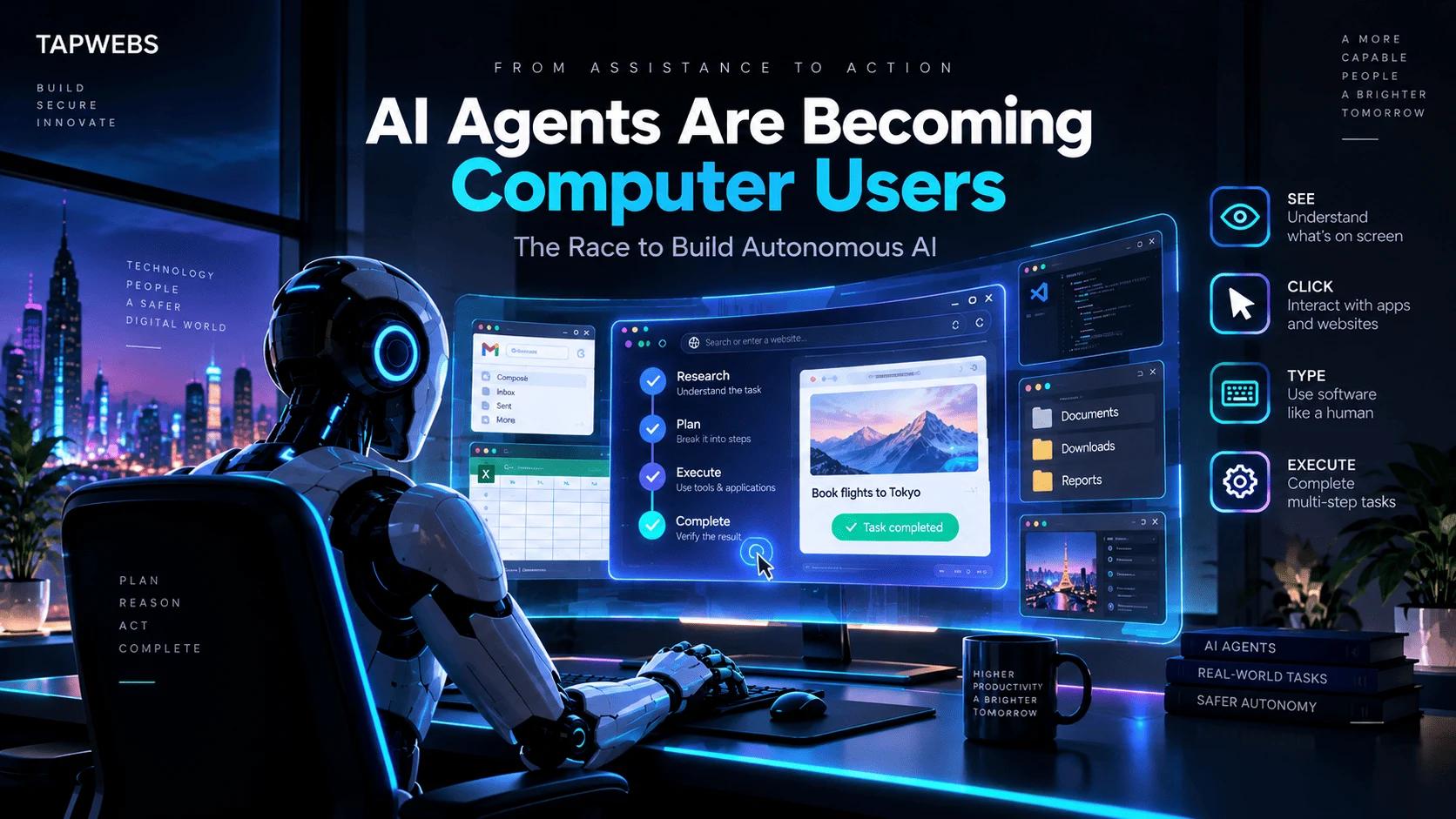
AI Agents Are Becoming Computer Users: The Race to Build Autonomous AI
For years, the dominant AI interaction model was simple:
Ask → Generate → Read.
In 2026, that model is changing.
The newest AI systems are increasingly being designed to see a computer screen, reason about what is happening, click buttons, type into applications, browse websites, use tools, and continue working through multi-step tasks.
OpenAI has pushed computer-use agents through its CUA research and newer agent products. Google integrated computer use directly into Gemini 3.5 Flash. Anthropic provides computer-use tooling that gives Claude screenshot, mouse, and keyboard control. Meta has now introduced Muse, a personal AI agent designed to operate through its own secure virtual computer.
The interesting question is no longer whether AI can understand a computer.
It is whether AI can reliably operate one.
From Chatbots to Computer-Using Agents
A traditional LLM waits for an instruction and returns an answer.
A computer-using agent operates in a loop:
Understand the goal → observe the environment → reason → take an action → observe the result → adjust → continue
That difference is significant.
Instead of asking:
"How do I submit this report?"
you could eventually tell an agent:
"Prepare the report, open the company portal, upload it, verify the submission, and tell me when it's done."
The AI doesn't simply explain the process. It attempts to perform the process.
OpenAI's original Computer-Using Agent, or CUA, demonstrated this approach by processing screenshots and controlling a virtual mouse and keyboard. Its system could click, scroll, type, adapt to unexpected interface changes, and ask for human intervention when a sensitive action required confirmation.
That basic architecture is now becoming a major direction across the AI industry.
The Computer-Use Race in 2026
Several major AI companies are approaching the problem differently.
| Company | Technology | What it can do | Notable direction |
| OpenAI | Computer-use agents / GPT-6 Astra | Browse, operate software, execute multi-step workflows | General-purpose computer use |
| Gemini 3.5 Flash computer use | Browser, desktop and mobile interaction | Fast agentic workflows | |
| Anthropic | Claude computer-use tool | Screenshots, mouse and keyboard control | Developer-controlled computer agents |
| Meta | Muse | Browser tasks, forms, email, travel and purchases | Personal autonomous agent |
This isn't one unified technology.
Each company is experimenting with a different combination of vision, reasoning, tool use, memory, planning, permissions and execution.
1. OpenAI: From Operator to More General Computer Agents
OpenAI's early Operator release demonstrated one of the first widely visible approaches to computer-using AI.
Its Computer-Using Agent was trained to interact with graphical interfaces using screenshots, mouse actions and keyboard input rather than relying exclusively on website-specific APIs. OpenAI reported 38.1% success on OSWorld, 58.1% on WebArena, and 87% on WebVoyager for its early CUA system.
Human performance on the OSWorld evaluation was reported at 72.4%, showing how significant the remaining gap was even at that stage.
The technology has since moved toward broader agent infrastructure.
OpenAI's 2026 Agents SDK updates introduced native sandbox execution and a model-native harness allowing agents to work with files, tools and computer environments while keeping execution isolated.
And with the September 2026 launch of GPT-6 Astra, OpenAI says computer use is among the model's state-of-the-art capabilities alongside coding, cybersecurity, science and professional work.
The direction is clear:
The computer is becoming an interface that AI can operate rather than merely describe.
2. Google: Gemini Gets Native Computer Use
Google took a particularly important step in June 2026 by integrating computer use directly into Gemini 3.5 Flash.
Google says the capability allows developers to build agents that can see, reason and take action across browser, mobile and desktop environments.
This matters because computer use is no longer being treated purely as a specialized experimental model.
It is becoming part of the broader model/tool ecosystem.
Google specifically highlights applications such as:
- Continuous software testing
- Enterprise automation
- Knowledge work
- Browser interaction
- Desktop workflows
- Mobile workflows
Google also positioned Gemini 3.5 Flash as an agent-oriented model optimized for fast execution, reporting that it runs four times faster than other frontier models in its published comparison.
The broader Gemini ecosystem is becoming increasingly agentic as well.
Google reported that the Gemini app had surpassed 900 million monthly users across 230 countries and more than 70 languages by May 2026, while introducing Gemini Spark and other proactive agent features.
3. Anthropic: Claude Gets Direct Computer Control
Anthropic has taken a developer-focused approach.
Its computer-use tool gives Claude access to a controlled desktop environment where it can receive screenshots and perform actions such as:
- Clicking
- Typing
- Scrolling
- Zooming
- Navigating applications
- Interacting with web pages
The current computer toolset exposes 17 member tools, including screenshot, mouse and keyboard actions.
Anthropic has also been pushing longer-running agentic workloads.
In February 2026, the company reported that among the longest Claude Code sessions, autonomous working time had nearly doubled in three months—from under 25 minutes to more than 45 minutes.
That is an important metric because agent usefulness isn't only about how intelligent a model is.
It is also about how long it can work correctly without losing track of the task.
4. Meta's Muse: The Agent Gets Its Own Computer
Meta's September 2026 launch of Muse takes the concept in another direction.
Rather than treating computer use simply as a developer API, Meta designed Muse as a personal AI agent with its own dedicated environment.
Muse operates inside Muse Secure VM, a dedicated virtual machine containing the agent, its browser and user data. Meta says Muse can perform tasks such as:
- Sending emails
- Booking travel
- Filling forms
- Browsing websites
- Planning projects
- Negotiating on a user's behalf
- Continuing longer tasks after the user closes the application
For sensitive operations, Muse can request approval before actions such as sending an email or making a purchase. Meta also says a separate Sentinel agent controls whether Muse can access the internet.
This architecture is particularly interesting because it recognizes an important problem:
An autonomous AI needs somewhere safe to operate.
Giving an AI unrestricted access to a user's real computer would create an enormous security and privacy problem.
A dedicated virtual environment provides an additional layer of isolation.
The Biggest Problem: Reliability
This is where the hype needs some perspective.
Computer-use agents are impressive, but they are not yet equivalent to reliable human operators.
A new benchmark called OSWorld 2.0 illustrates why.
OSWorld 2.0 contains 108 long-horizon computer-use workflows designed around realistic professional and everyday tasks. The tasks take a human a median of approximately 1.6 hours and require an average of 318 tool calls with Claude Opus 4.7 under the benchmark's evaluation setup.
The results are revealing.
Under the benchmark's primary 500-step completion metric, the best reported system in that evaluation—Claude Opus 4.8 with maximum thinking and batched tool calls—completed only 20.6% of tasks, with a 54.8% partial-completion score. GPT-5.5 was reported at approximately 13% on the same primary metric.
That's a long way from a human-level autonomous employee.
The failures aren't necessarily basic clicking mistakes.
Agents can lose track of constraints, miss information that appears later, infer hidden application state incorrectly, guess instead of asking for clarification, or fail to verify whether an action actually succeeded.
This is one of the most important realities of agentic AI in 2026:
Making an AI capable of using a computer is easier than making it reliably use a computer.
Why Computer Use Is Harder Than Chat
A chatbot can often produce a useful response even when it makes a minor mistake.
A computer agent has a much smaller margin for error.
Imagine an agent booking a flight.
It needs to:
- Search the correct dates.
- Understand the available options.
- Select the correct flight.
- Confirm passenger details.
- Avoid unwanted upgrades.
- Enter the correct information.
- Recognize the final price.
- Verify the booking.
- Know whether the transaction actually succeeded.
One incorrect click can invalidate the entire workflow.
This creates a new requirement for AI systems:
Verification.
An agent shouldn't simply ask:
"Did I complete the task?"
It needs mechanisms that can independently determine whether the desired state was actually reached.
What Happens Next?
The next generation of AI agents will likely compete on several dimensions simultaneously.
| Capability | The question that matters |
| Reasoning | Can the agent understand a complex goal? |
| Computer use | Can it reliably operate real software? |
| Memory | Can it maintain context over long tasks? |
| Tools | Can it choose the right tool at the right time? |
This is why the AI race is increasingly becoming an agent race.
The winning model may not be the one that writes the most impressive answer.
It may be the one that can take a vague objective, turn it into a plan, interact with software, recover from mistakes, verify the result and safely deliver the finished work.
The Bigger Shift: AI Is Becoming an Interface to Software
For decades, humans learned how to operate computers.
We learned:
Files → folders → applications → menus → buttons → commands
Now AI systems are learning the same interfaces.
That could have enormous consequences.
Software doesn't necessarily need a custom AI integration for every task if an agent can operate the existing interface.
A legacy application without an AI API could potentially become usable by an AI agent simply because the agent can see the screen and operate the interface.
That is one of the most powerful ideas behind computer-use AI.
But it also creates a paradox:
The more capable the agent becomes, the more carefully it must be controlled.
An AI that cannot act is limited.
An AI that can act without reliable safeguards is dangerous.
The real goal is therefore somewhere in between:
Highly capable AI with controlled autonomy.
Final Verdict
The AI industry is moving from generating information to executing work.
OpenAI is developing agents that can operate computers and complete increasingly complex workflows. Google has brought computer use directly into Gemini 3.5 Flash. Anthropic provides direct desktop interaction through its computer-use tooling. Meta's Muse takes the concept further by giving a personal agent its own secure virtual computer.
But today's agents are still far from perfect.
The OSWorld 2.0 results make that clear: even leading systems struggle with long, realistic workflows involving hundreds of actions and hidden state.
The next major breakthrough in AI may therefore not be another chatbot that produces better answers.
It may be an agent that can reliably take a goal, operate the software required to achieve it, verify its own work, and know when it should ask a human for help.
That is the race currently underway.
Tags