The Biggest AI Releases of 2026 So Far: What Actually Changed?
2026 has been a major year for artificial intelligence, with new frontier models, AI agents, computer-use systems, multimodal tools, and AI infrastructure changing what software can actually do. Here are the biggest AI releases of 2026—and the capabilities that made a real difference.
The Biggest AI Releases of 2026 So Far: What Actually Changed?
2026 has not simply been another year of larger language models.
The biggest shift has been what AI systems can actually do.
Instead of stopping at generating text, images, or code, the newest generation of AI can increasingly operate software, browse the web, use tools, write and test code, create complete work products, manage long-running tasks, and interact with computers with much less human supervision.
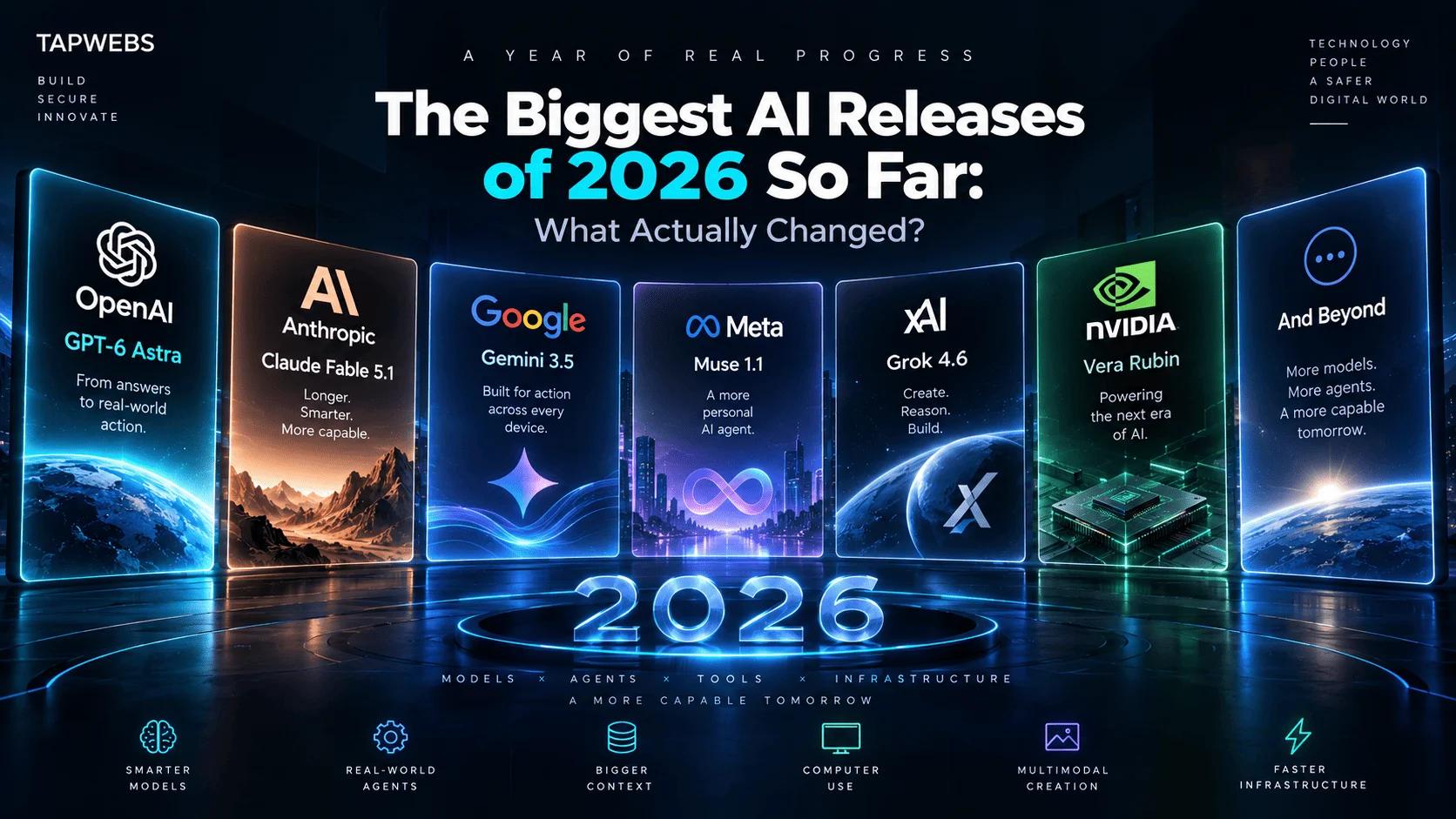
OpenAI's GPT-6 Astra, Anthropic's Claude Fable 5.1 and Opus 5, Google's Gemini 3.5 family, Meta's Muse models, xAI's Grok 4.6, and NVIDIA's Vera Rubin platform all represent different pieces of the same transition: AI is moving from content generation toward execution and autonomous work.
So which AI releases actually mattered in 2026?
What Changed in AI During 2026?
The most important releases can be grouped into six major shifts:
| 2026 AI Shift | What Changed |
| AI Agents | Models can plan and execute multi-step tasks |
| Computer Use | AI can interact with browsers, desktops and applications |
| Agentic Coding | AI can build, test, debug and modify software |
| Long-Running AI | Agents can work for hours or across multiple sessions |
| Multimodal AI | Text, images, video, audio and software interaction increasingly converge |
| AI Infrastructure | New chips and systems are being designed specifically for agentic inference |
This is why 2026 feels different from earlier AI model cycles.
The question is increasingly moving from “How intelligent is the chatbot?” to “How much work can the AI complete without being constantly directed?”
1. OpenAI GPT-6 Astra: AI Moves Toward End-to-End Work
One of the year's most significant releases arrived on September 3, 2026, when OpenAI introduced GPT-6 Astra.
OpenAI positions Astra as its most capable model, with state-of-the-art performance across computer use, browsing, software engineering, cybersecurity, science and professional work.
The important change is not simply another benchmark improvement.
Astra is designed to perform complete workflows.
It can:
- Fill out online forms
- Update CRM records
- Research information online
- Create documents and spreadsheets
- Build presentations
- Generate websites
- Run frontend quality checks
- Install and test software
- Analyze scientific data
- Work through multi-step professional tasks
OpenAI reports 98% on FrontierMath Tier 4, 99.9% on ARC-AGI-3, and 100% on ExploitBench in its published evaluations.
Computer-use performance also became substantially more efficient. On OpenAI's OSWorld 2.0 latency simulation, Astra achieved 72.6% at roughly 40 minutes per task, compared with GPT-5.6 Sol's 65.7% at approximately 75 minutes—a roughly 47% reduction in simulated task time.
Why it matters
The material change is execution.
A traditional AI workflow looks like:
Ask → Receive answer → Human executes
An agentic workflow increasingly looks like:
Goal → Plan → Use tools → Execute → Verify → Deliver
That distinction could be more important than another incremental increase in chatbot benchmark scores.
2. Claude Fable 5.1: Long-Running AI Becomes More Practical
Anthropic's Claude Fable 5 generation pushed another major frontier: long-running autonomous work.
Claude Fable 5 was introduced in June 2026 specifically for complex tasks that could span days and operate asynchronously. Fable 5.1 followed on September 1 as Anthropic's most capable model for coding and knowledge work.
Fable 5.1 is designed for work that can take hours and span multiple applications.
It can:
- Operate browsers
- Work across applications
- Handle large coding projects
- Perform code review
- Write and run tests
- Conduct research
- Analyze documents
- Work with diagrams and PDFs
- Operate as a managed agent
- Continue multi-day coding workflows
Anthropic says Fable 5.1 can plan work, use required tools, recover from failed steps and keep users updated during long-running tasks.
The economics also changed.
Fable 5.1 is priced at $10 per million input tokens and $50 per million output tokens, while cache reads are priced at $0.25 per million tokens. Anthropic estimates this can reduce typical workload costs by around 25% and highly agentic workload costs by up to approximately 45% compared with Fable 5.
Why it matters
AI agents become much more useful when they don't need to be restarted every few minutes.
The important capability is therefore not simply:
“Can the model solve the problem?”
It is:
“Can the model stay oriented while solving the problem for hours?”
That is a fundamentally different product requirement.
3. Claude Opus 5: Agentic Coding Gets Cheaper
Anthropic also released Claude Opus 5 in July 2026, targeting long-running agents, coding and professional work.
Anthropic reported that Opus 5 delivered major gains over Opus 4.8 while retaining the same base pricing: $5 per million input tokens and $25 per million output tokens.
One particularly important result came from computer-use testing.
Anthropic reported that Opus 5 outperformed other models at a given cost on OSWorld 2.0, while also delivering stronger results on agentic coding and knowledge-work evaluations.
The model also showed substantial gains in scientific workflows. On one internal organic chemistry evaluation, Anthropic reported a 10.2 percentage-point improvement over Opus 4.8, while protein-function prediction improved by 7.7 percentage points.
Why it matters
AI capability is only useful at scale if the economics work.
2026 therefore became increasingly about:
Capability × Reliability × Cost × Runtime
A model that is 5% better but dramatically more expensive may not win production workloads.
A model that is substantially better per dollar can.
4. Google Gemini 3.5: AI Gets Built for Action
Google's Gemini 3.5 family represents another major shift.
At Google I/O 2026, Google introduced Gemini 3.5 Flash, describing it as the first model in the family combining frontier intelligence with action.
Google reported:
- 76.2% on Terminal-Bench 2.1
- 1656 Elo on GDPval-AA
- 83.6% on MCP Atlas
- 84.2% on CharXiv Reasoning
Google also positioned 3.5 Flash as significantly faster than other frontier models in its published comparison.
But the bigger release was what came next.
Gemini 3.5 Flash Gets Native Computer Use
In June, Google integrated computer use directly into Gemini 3.5 Flash.
The model can now see, reason and act across browser, mobile and desktop environments.
That opens the door to agents capable of:
- Software testing
- Browser automation
- Enterprise workflows
- Knowledge work
- Desktop automation
- Mobile interactions
- Multi-step application workflows
Google essentially moved computer use from being a specialized capability toward becoming part of the model's standard agentic toolkit.
5. Gemini Omni: Multimodal AI Moves Beyond Chat
Google also introduced Gemini Omni at I/O 2026.
The idea is different from simply making a chatbot smarter.
Gemini Omni is designed around creation from multimodal inputs, with Google initially emphasizing video generation and editing. Users can combine text, images, audio and video as inputs and generate or modify video through conversation.
This matters because generative AI is increasingly becoming less about individual models for individual media types.
The direction is toward systems that can understand:
Text + Image + Audio + Video + Code + Software Interfaces
within one workflow.
That convergence could become one of the most important long-term AI trends of the decade.
6. Meta Muse Spark 1.1: The OpenAI/Anthropic Model Race Gets Another Competitor
Meta made a major push into frontier AI through its Muse model family.
Meta introduced Muse Spark in April 2026 as a natively multimodal reasoning model supporting tool use, visual reasoning and multi-agent orchestration.
Then came Muse Spark 1.1 in July.
Meta describes it as a multimodal reasoning model specifically optimized for:
- Agentic tasks
- Tool use
- Computer use
- Coding
- Multimodal understanding
Meta also opened a public preview of its Meta Model API, allowing developers to build with Muse Spark 1.1.
One especially notable capability is its million-token context positioning for large-scale agentic workloads.
Why it matters
The frontier model market is no longer just about who has the strongest chatbot.
Meta is competing on a different strategic advantage:
multimodality + agents + huge context + developer distribution + consumer reach.
7. Meta Muse: The AI Assistant Becomes an Agent
Meta's September 2026 Muse launch pushes the idea even further.
Muse is designed as a personal AI agent capable of performing tasks across applications rather than simply answering questions.
Meta says Muse can perform tasks such as:
- Sending email
- Booking travel
- Filling forms
- Shopping
- Managing workflows
- Working through its own browser
- Continuing tasks after the application is closed
The system uses a dedicated environment and additional safety mechanisms to control what the agent can access.
This represents an important product shift.
The AI assistant is no longer necessarily something you talk to.
It can become something you delegate to.
8. Grok 4.6: Long-Running Agents Become a Product Category
xAI also pushed further into agentic AI with Grok 4.6, released in August 2026.
xAI says Grok 4.6 was designed specifically for long-running agents and ambitious interactive work. It can stay with complex tasks involving research, analysis, codebases and the creation of applications or other work artifacts.
Grok 4.6 reportedly matched GPT-5.6 Sol on the Artificial Analysis Intelligence Index in xAI's published comparison.
But xAI's more interesting product move was Grok Build.
Grok Build lets users describe an:
- App
- Website
- Game
- Dashboard
and have Grok create a working version directly in the chat.
By August, xAI had expanded Grok Build to every plan on web and mobile and added the ability to publish and share creations.
This is another sign of the same trend:
AI is moving from generating code to generating working software.
9. Codex Changed What an AI Coding Tool Means
One of the quieter but potentially more important developments of 2026 has been the transformation of coding agents.
OpenAI's Codex app launched in February as a command center for managing multiple AI agents in parallel. It supports long-running work, project-based organization, agent review and configurable sandboxing.
The scale of adoption also changed quickly.
OpenAI reported in June that Codex had surpassed 5 million weekly active users, with knowledge workers accounting for around 20% of users and growing more than three times as fast as developers.
That is significant because it suggests coding agents are expanding beyond programmers.
People are using them for:
- Reports
- Presentations
- Data analysis
- Research
- Spreadsheets
- Workflow automation
- Lightweight applications
The coding agent is gradually becoming a general-purpose work agent.
10. NVIDIA Vera Rubin: The Hardware Is Changing Too
The AI race isn't only happening at the model layer.
In March 2026, NVIDIA introduced its Vera Rubin platform, built around seven new chips designed to scale AI factories and agentic inference.
The platform includes:
- Vera Rubin GPUs
- Vera CPUs
- NVLink 6 switches
- ConnectX-9 networking
- BlueField-4 DPUs
- Spectrum-6 networking
- Groq 3 LPUs
NVIDIA specifically positioned the platform around the entire AI lifecycle—from pretraining and post-training to test-time scaling and real-time agentic inference.
Why this matters
The AI industry is discovering that agents require enormous inference capacity.
A chatbot might answer once.
An agent may:
Reason → Search → Open application → Read screen → Call tool → Write code → Run test → Inspect result → Retry → Verify → Report
That can require many more inference operations per task.
Therefore, agentic AI is also becoming an infrastructure problem.
The 2026 AI Release Landscape
The biggest releases can now be viewed as different approaches to the same underlying problem.
| Release | Main Breakthrough | Why It Matters |
| GPT-6 Astra | Computer use + professional work | AI can execute complete workflows |
| Claude Fable 5.1 | Long-running autonomous work | Better for multi-hour/multi-day tasks |
| Claude Opus 5 | Agentic coding efficiency | More capability per dollar |
| Gemini 3.5 Flash | Fast agentic reasoning + computer use | Makes action-oriented AI more scalable |
| Gemini Omni | Multimodal creation | Text, image, audio and video converge |
| Muse Spark 1.1 | Multimodal agentic AI | Meta enters serious agent infrastructure |
| Muse | Personal computer-using agent | AI begins acting across applications |
| Grok 4.6 / Grok Build | Long-running agents + software creation | Natural-language-to-working-software workflows |
| Codex | Multi-agent development | AI coding expands into general knowledge work |
| NVIDIA Vera Rubin | Agentic AI infrastructure | Hardware optimized for inference-heavy AI |
What Actually Changed in 2026?
Looking at the launches individually can make 2026 look like another model-number race.
It isn't.
The deeper change is that AI is becoming operational.
1. From answers to outcomes
Earlier AI systems primarily generated an answer.
New systems increasingly receive an objective and work toward an outcome.
2. From one-shot prompts to long-running tasks
Models can now maintain context, use tools, recover from failures and continue working for much longer periods.
3. From code generation to software engineering
AI coding systems increasingly:
- Inspect repositories
- Plan changes
- Modify files
- Run tests
- Debug failures
- Review their own work
- Iterate
The human role moves closer to architect, reviewer and supervisor.
4. From browser search to computer use
AI can increasingly interact with the same interfaces humans use.
That means the model doesn't always need a custom API for every task.
It can potentially operate the existing software directly.
5. From multimodal generation to multimodal action
AI systems increasingly understand combinations of:
text + images + audio + video + screens + software
and can act on that information.
6. From individual models to agent ecosystems
The important product is no longer always the model itself.
It is becoming:
Model + Tools + Memory + Computer Access + Sandbox + Verification + Monitoring
That is the architecture behind useful autonomous AI.
The Biggest Limitation: AI Still Isn't Fully Autonomous
Despite the impressive releases, 2026 has not produced perfectly reliable autonomous workers.
Computer-use and agentic systems still struggle with:
- Unexpected application states
- Ambiguous instructions
- Authentication barriers
- Long task chains
- Incorrect assumptions
- Tool failures
- Hallucinated actions
- Security boundaries
- Verification
- Cost of extended inference
This is why the industry's most important metric may eventually become task completion reliability, rather than benchmark intelligence alone.
A model scoring 95% on a benchmark is impressive.
An enterprise needs to know whether its agent can complete 1,000 real workflows safely and consistently.
That is a much harder problem.
AI Security Became More Important Too
More capable agents also create a larger attack surface.
A chatbot that produces incorrect text is one problem.
An AI agent that can:
- Open websites
- Read files
- Access APIs
- Execute commands
- Send messages
- Modify databases
- Deploy software
can potentially turn a model mistake into a real-world incident.
That is why 2026 AI releases increasingly include:
- Sandboxing
- Permission systems
- Human approval
- Monitoring
- Action limits
- Audit trails
- Safety classifiers
- Environment isolation
OpenAI's GPT-6 Astra, for example, includes additional monitoring designed to detect cases where the agent may not have interpreted instructions correctly.
The next stage of AI therefore isn't just about making agents more capable.
It is about making them capable enough to work and controlled enough to trust.
Final Verdict
2026 has been the year AI started moving beyond generation and toward execution.
GPT-6 Astra pushed computer use and professional workflows. Claude Fable 5.1 and Opus 5 pushed long-running agents and coding. Gemini 3.5 brought action-oriented intelligence and native computer use. Gemini Omni expanded multimodal creation. Meta's Muse models pushed personal and agentic AI. Grok moved toward long-running agents and natural-language software creation. NVIDIA redesigned infrastructure around the enormous inference requirements of agentic AI.
The biggest AI release of 2026 therefore isn't necessarily one model.
It is the transition from AI that generates answers to AI that can perform work.
And that shift is only beginning.
Tags