Why India Is Becoming a Global Cybersecurity and AI Hub in 2026
India's technology ecosystem is expanding beyond IT services into AI, cybersecurity, startups, research and digital infrastructure. Explore the factors shaping India's growing role in the global AI and cybersecurity landscape in 2026.
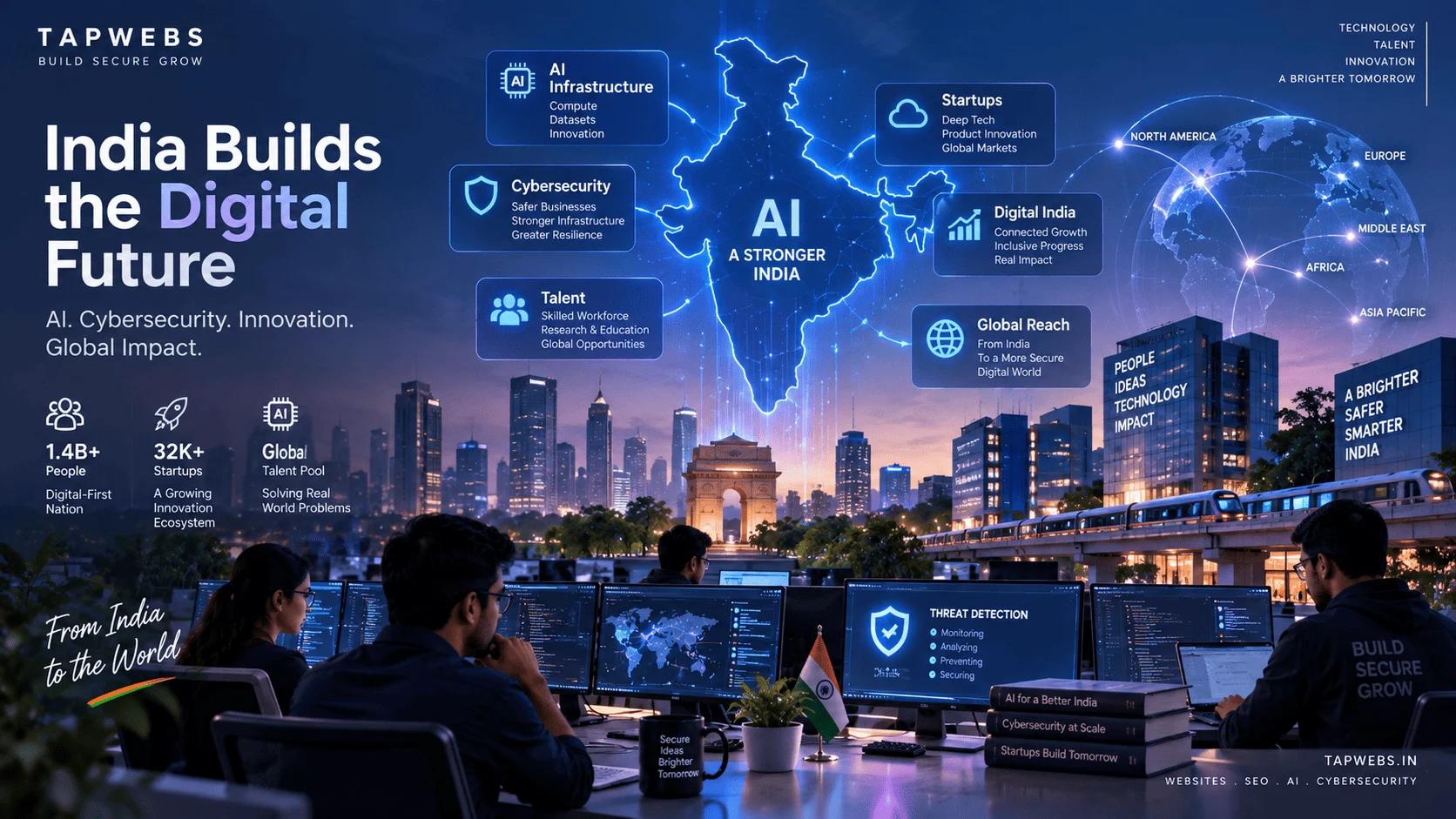
India's Technology Ecosystem Is Changing
For decades, India has been widely recognized for its information technology services, software engineering and large technology workforce.
That role is now expanding.
India's technology ecosystem increasingly includes:
- Artificial intelligence
- Generative AI
- AI infrastructure
- Cybersecurity
- Deep-tech startups
- Global Capability Centers
- Semiconductor and electronics initiatives
- Digital public infrastructure
- Cloud computing
- Enterprise software
- Research and innovation
NASSCOM's 2026 Technology Sector Strategic Review describes AI as moving from an optional technology toward core infrastructure, while agentic systems are increasingly shifting AI from assistance toward execution.
At the same time, India's national AI programs are building infrastructure around compute, datasets, models, skills, startups and responsible AI.
This combination is important because a technology ecosystem is not built by one company or one government program.
It develops when talent, infrastructure, capital, research, startups and customers begin reinforcing each other.
Why AI Is Becoming Strategic for India
AI is increasingly being treated as infrastructure rather than simply another software feature.
India's approach includes several interconnected areas:
| Area | Why It Matters |
| AI Compute | Provides access to computing resources for AI development |
| Datasets | Supports training, research and application development |
| Foundation Models | Enables development of Indian AI capabilities |
| Skills | Builds the workforce needed to develop and deploy AI |
| Startups | Encourages commercialization and new products |
The IndiaAI Mission was approved in 2024 around seven pillars covering areas including compute, datasets, foundation models, future skills, startups, financing and safe and trusted AI.
The IndiaAI Compute Portal also makes AI compute services available to groups including startups, MSMEs, researchers, students and industry, with the stated objective of making AI compute more accessible.
This matters because access to compute can be one of the biggest barriers for smaller AI companies.
IndiaAI Mission and National AI Infrastructure
India's AI ecosystem is increasingly being supported by national infrastructure.
A simplified view looks like this:
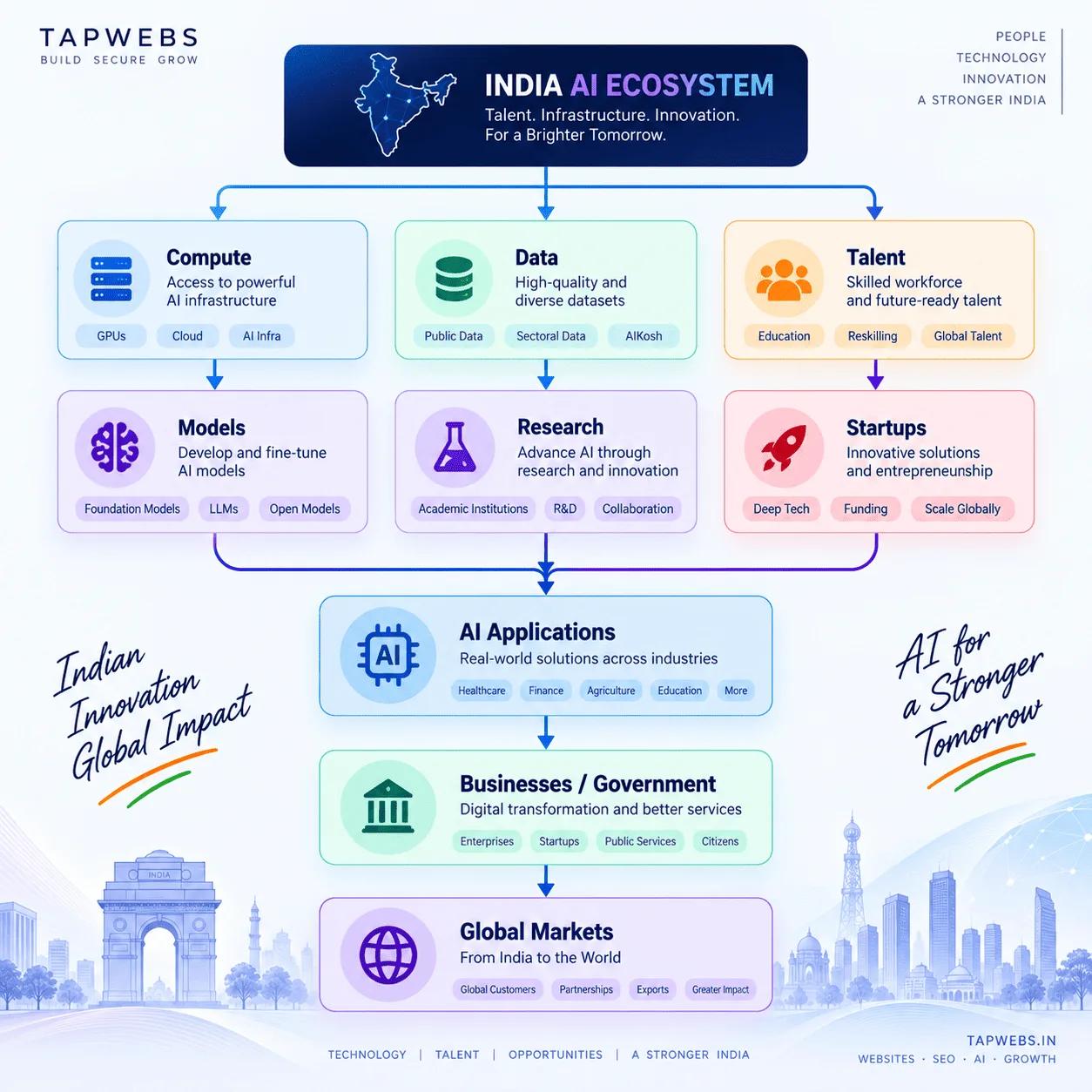
IndiaAI's ecosystem includes platforms such as AIKosh, which provides access to datasets, models, toolkits and AI resources for researchers, developers and students.
The objective is broader than building individual AI applications.
It is about creating an environment where organizations can develop, test and deploy AI systems within India.
India's Growing AI Startup Ecosystem
India already has a large technology startup base, and AI is becoming increasingly important within that ecosystem.
NASSCOM reported in 2025 that India's technology startup ecosystem had grown from roughly 2,000 tech startups in 2014 to approximately 32,000–35,000 active startups in 2024, with around 4,000 deep-tech startups.
AI startups are emerging across multiple areas, including:
- Generative AI
- Healthcare
- FinTech
- Cybersecurity
- Education
- Agriculture
- Enterprise software
- Customer support
- Developer tools
- Language technology
- Computer vision
- Robotics
This diversity is important.
AI does not need to produce only another general-purpose chatbot.
Some of the most useful applications may be highly specialized systems solving problems specific to an industry or region.
The Role of India's Technology Talent
Talent is one of India's most important technology advantages.
India already has a large software engineering ecosystem, while AI is creating demand for new capabilities.
These include:
- Machine learning
- Data engineering
- AI engineering
- Cloud infrastructure
- Cybersecurity
- MLOps
- LLMOps
- AI product development
- Responsible AI
- AI security
NASSCOM's 2026 research on human–AI collaboration reports that AI is already being used across functions in Indian technology organizations and highlights employee productivity and customer satisfaction among key AI-related KPIs.
However, having a large workforce is not enough.
The important question is whether the workforce can continuously adapt as AI changes software engineering, security, data and business processes.
That makes reskilling an important part of India's AI strategy.
Why Cybersecurity Is Becoming More Important
The growth of AI and digital infrastructure also increases the importance of cybersecurity.
More businesses are operating through:
- Cloud infrastructure
- APIs
- SaaS applications
- Digital payments
- Mobile applications
- Connected devices
- AI systems
- Data platforms
Each additional digital system creates another potential attack surface.
CERT-In remains India's national agency for responding to computer security incidents and coordinating cybersecurity response activities.
The scale of the country's cybersecurity environment is significant.
According to MeitY's 2025–26 annual report, CERT-In handled 2,944,248 incidents during 2025, while issuing 1,530 security alerts, 65 advisories and 390 vulnerability notes.
The same report states that 234 information-security auditing organizations were empanelled by CERT-In in 2025 for security auditing, including vulnerability assessment and penetration testing.
These figures illustrate why cybersecurity capacity is becoming an increasingly important component of India's digital economy.
India's Cybersecurity Infrastructure
India's cybersecurity ecosystem involves government agencies, private companies, security researchers, startups, enterprises and academic institutions.
The ecosystem can be viewed as:
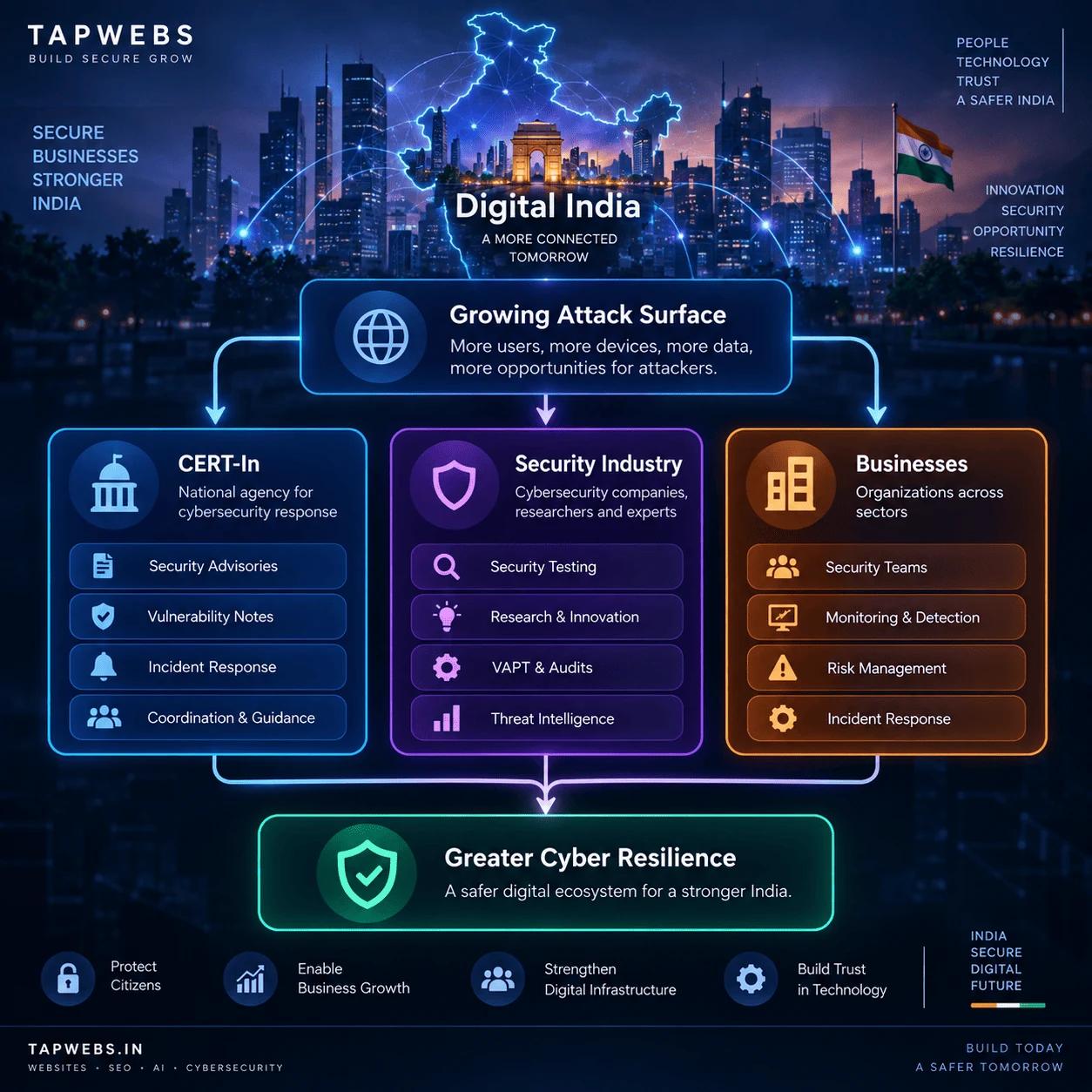
CERT-In's work includes incident response, security alerts, advisories, vulnerability information, coordination and cybersecurity exercises.
The agency has also introduced new guidance specifically addressing AI-assisted vulnerability exploitation.
In May 2026, CERT-In published a blueprint focused on reducing exposure and defending digital infrastructure against AI-assisted vulnerability exploitation.
That development shows how closely AI and cybersecurity are beginning to intersect.
AI and Cybersecurity Are Converging
AI and cybersecurity are increasingly becoming two sides of the same technology landscape.
AI can create new security risks, but it can also improve defensive capabilities.
| AI Creates New Risks | AI Can Strengthen Defense |
| Automated reconnaissance | Automated threat analysis |
| AI-assisted phishing | Phishing detection |
| Faster vulnerability research | Faster vulnerability discovery |
| AI-enabled malware | Behavioral detection |
CERT-In issued an advisory in April 2026 warning about emerging frontier-AI cyber capabilities, including large-scale software analysis, vulnerability discovery, automated reconnaissance and multi-stage attack planning.
This means India needs capabilities in both AI development and AI security.
The opportunity is therefore not simply to build more AI systems.
It is also to build systems that are:
- Secure
- Auditable
- Resilient
- Privacy-conscious
- Properly governed
- Tested against adversarial behavior
Opportunities for Indian Startups and Businesses
The growth of AI and cybersecurity creates opportunities across several layers of the technology economy.
1. AI Products
Indian startups can develop specialized AI products for:
- Healthcare
- Finance
- Education
- Agriculture
- Manufacturing
- Retail
- Government
- Legal services
- Enterprise operations
2. AI Infrastructure
Opportunities exist around:
- Cloud infrastructure
- Compute
- Data platforms
- Model operations
- AI deployment
- AI observability
3. Cybersecurity
The increasing digital attack surface creates demand for:
- VAPT
- Application security
- Cloud security
- API security
- Identity security
- SOC services
- Threat intelligence
- Security automation
- AI security
4. AI + Cybersecurity
One of the most interesting areas is the intersection between the two.
Examples include:
- AI-powered vulnerability management
- Automated security analysis
- AI-assisted SOC operations
- Threat-intelligence automation
- Secure AI development
- AI red teaming
- AI application security
This intersection is likely to become increasingly important as organizations deploy more AI systems.
Challenges India Still Needs to Address
The growth opportunity does not mean that India's technology ecosystem has no challenges.
Several areas require continued attention.
Access to Compute
Advanced AI development can require significant computing resources.
National and private infrastructure can help reduce this barrier, but compute availability and economics remain important considerations.
AI Talent
Demand for experienced AI engineers, researchers and security professionals continues to evolve.
Education and continuous reskilling therefore matter.
Research and Innovation
Building globally competitive technology requires more than implementation skills.
Research, intellectual property and deep technical capabilities are also important.
Cybersecurity
More digital infrastructure means more potential targets.
Security needs to be built into AI and digital products rather than treated as an afterthought.
Responsible AI
AI systems increasingly affect businesses, individuals and public services.
Questions around:
- Privacy
- Bias
- Security
- Transparency
- Accountability
- Safety
will therefore become increasingly important.
India's AI programs explicitly include Safe & Trusted AI as one of the IndiaAI Mission pillars.
India’s Position in the Global Technology Landscape
India's role is also becoming increasingly connected to global technology markets.
The opportunity is not limited to building products for India.
Indian companies can build for:
- North America
- Europe
- Middle East
- Southeast Asia
- Africa
- Global SaaS markets
This creates an important shift.
India can simultaneously be:
a technology services hub,
a product-development hub,
an AI innovation ecosystem,
and
a cybersecurity capability center.
NASSCOM's 2025 strategic review identified India's strengthening position as a global technology and innovation hub, supported by its technology ecosystem, talent base, digital infrastructure and growing presence of Global Capability Centers.
What This Means for Indian Businesses
The AI and cybersecurity transformation is not limited to large technology companies.
Indian SMEs and startups are also becoming part of the digital ecosystem.
For a smaller business, the priorities can be practical:
Build a secure digital foundation
- Professional website
- Secure hosting
- HTTPS
- Strong authentication
- Regular backups
- Security monitoring
Adopt AI where it solves a real problem
- Customer support
- Lead qualification
- Content operations
- Analytics
- Internal automation
- Business workflows
Protect business data
Understand:
- Where data is stored
- Which AI tools can access it
- Who has access
- Which third-party services receive it
Prepare for AI-powered search
Businesses should also ensure that their websites contain clear, structured and useful information that can be discovered through modern search systems.
Conclusion
India's technology story is entering another phase.
The country already has a large software and IT-services ecosystem.
Now AI, cybersecurity, cloud infrastructure, startups, digital platforms and advanced technology research are becoming increasingly interconnected.
The IndiaAI Mission is building infrastructure around compute, datasets, models, skills, startups and responsible AI, while organizations such as CERT-In continue expanding the country's cybersecurity preparedness.
At the same time, India's startup ecosystem and technology workforce provide a foundation for companies developing products and services for both domestic and international markets.
The next chapter is therefore not simply about whether India can adopt AI.
It is about whether India can build, secure and export the technologies that shape the next generation of the digital economy.
For Indian startups, SMEs and technology professionals, that creates a particularly important opportunity:
build for India, secure for the world, and compete globally.